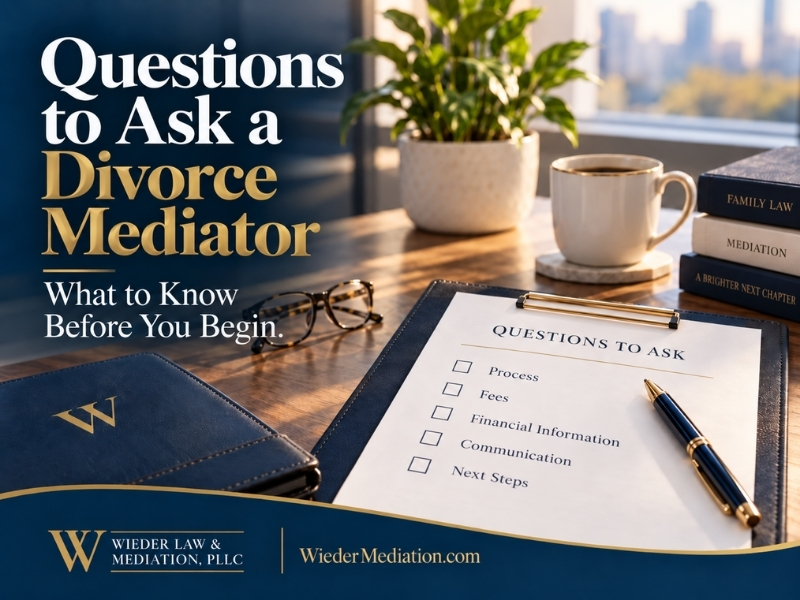
Choosing a divorce mediator is an important decision.
Choosing a divorce mediator is an important decision, and knowing the right questions to ask a divorce mediator before you begin can help you better understand the process and what to expect.
You may already know that you want a more structured way to work through the decisions involved in divorce. You may value privacy, want more direct participation in the process, or simply want to understand whether mediation is a reasonable option before deciding how to proceed.
Before beginning divorce mediation, it helps to understand how the mediator works, what the mediator’s role will be, what will be expected of both spouses, and what happens if some issues cannot be resolved.
The questions to ask a divorce mediator should help you evaluate more than credentials or cost. They should give you a clearer picture of how the mediator approaches communication, financial information, difficult discussions, fees, and the steps that follow if an agreement is reached.
A good initial conversation should leave you with more clarity about the process, not promises about the outcome.
1. What Is Your Role as the Divorce Mediator?
This is one of the most important questions you can ask.
A divorce mediator is neutral. The mediator does not represent either spouse individually and does not decide who is right or wrong.
Instead, the mediator helps spouses:
- Identify the issues that need to be addressed
- Organize relevant information
- Communicate more effectively
- Clarify areas of disagreement
- Explore possible solutions
- Work toward terms they both choose to accept
The American Bar Association’s explanation of mediation similarly describes the mediator as a neutral third person who helps parties clarify issues, consider options, and work toward a voluntary agreement.
Understanding this distinction at the beginning can prevent confusion later.
2. How Does Your Mediation Process Work?
Mediation practices can differ.
Ask how the mediator structures the process from the first consultation through a possible final agreement.
Questions may include:
- Is there an intake process?
- What information should we provide before the first session?
- Are sessions usually joint?
- Are private sessions ever used?
- How long are sessions?
- How often are they scheduled?
- What happens between sessions?
- How are agreements documented?
You can also review The Mediation Process for an overview of how mediation may be structured at Wieder Law & Mediation.
3. How Do You Determine Whether Mediation Is Appropriate?
Mediation is not automatically appropriate for every divorce.
A thoughtful mediator should consider whether each spouse can participate meaningfully and voluntarily.
Concerns may include:
- Serious intimidation or coercion
- An inability to communicate safely
- Refusal to provide important financial information
- Immediate legal or financial concerns
- A significant imbalance in access to information
- One spouse using mediation primarily to delay decisions
Some concerns may be addressed through changes in the process.
Others may require a different approach.
A mediator should be willing to discuss those limitations honestly.
4. How Is Financial Information Exchanged?
Financial disclosure is an important part of many divorces.
Spouses may need to gather information concerning:
- Income
- Bank accounts
- Retirement assets
- Investments
- Real estate
- Business interests
- Debts
- Insurance
- Taxes
- Household expenses
Ask how documents are collected and exchanged.
Does the mediator provide a checklist? Are documents exchanged before sessions? What happens if something appears to be missing?
Our existing guide, What to Bring to Divorce Mediation in New York, may also help with preparation.
5. How Do You Handle Difficult Conversations?
People do not usually seek divorce mediation because communication is going perfectly.
Ask what happens when discussions become emotional or unproductive.
A mediator may:
- Slow the conversation down
- Clarify the specific issue
- Separate facts from assumptions
- Reframe inflammatory language
- Help each spouse identify the concern behind a position
- Pause a discussion until more information is available
- Use private sessions when appropriate
No mediator can guarantee that every conversation will be comfortable.
The goal is to provide structure when the spouses are struggling to create that structure themselves.
6. How Does Your Legal Background Inform the Mediation Process?
When a mediator is also an attorney, legal training can be valuable in helping spouses identify the issues that need to be addressed and understand the legal significance of those issues.
The important distinction is that the mediator remains neutral.
The mediator is not acting as either spouse’s individual attorney and is not advocating for one person’s preferred outcome. Instead, the mediator uses legal knowledge to help structure the discussion, identify questions that need to be resolved, and make sure important issues are not overlooked.
You may want to ask:
- How does your legal background shape the way you conduct mediation?
- How do you explain legal concepts while remaining neutral?
- How do you help spouses identify issues that may require additional information?
- How do you distinguish general legal information from individual legal advice?
- How are final agreements and next steps handled once terms are reached?
For many spouses, working with an attorney-mediator can provide the benefit of a legally informed process while allowing both participants to remain directly involved in their decisions.
7. When Might We Need Other Professionals?
Some divorces involve questions requiring expertise outside the mediator’s role.
Depending on the circumstances, spouses may consult:
- Accountants
- Tax professionals
- Financial advisors
- Business valuation professionals
- Real estate appraisers
- Retirement specialists
Ask the mediator how outside professionals may be incorporated into the process when needed.
8. What Happens If We Strongly Disagree on One Issue?
A disagreement does not mean mediation has failed.
Ask how the mediator handles a significant impasse.
The mediator may help the spouses:
- Clarify what is actually disputed
- Identify missing information
- Understand the concerns underlying each position
- Develop several possible options
- Obtain outside advice
- Temporarily set the issue aside
The mediator does not impose the answer.
9. What Happens If We Cannot Resolve Everything?
Not every mediation ends with a complete agreement.
Sometimes spouses resolve most issues but remain apart on one or two.
Depending on the circumstances, they may:
- Continue mediation later
- Obtain additional information
- Seek independent legal advice
- Use attorney negotiation
- Resolve the remaining issue through another process
Partial agreement can still reduce the number of issues that remain.
10. How Long Does Divorce Mediation Usually Take?
There is no single timeline that applies to every divorce.
The length of mediation may depend on:
- The number of issues
- The complexity of the finances
- How quickly information is exchanged
- The availability of the spouses
- Whether outside professionals are needed
- How far apart the spouses are on major issues
Be cautious of anyone promising an exact timeline without knowing the circumstances.
11. How Are Mediation Fees Structured?
Ask about fees before the process begins.
Questions might include:
- Is the mediator paid hourly?
- Is there a retainer?
- Is preparation billed?
- Are emails and phone calls billed?
- Is document preparation separate?
- How are canceled sessions handled?
- How will payment responsibility be divided?
Clear expectations around billing can prevent another source of disagreement later.
12. What Happens After We Reach an Agreement?
Agreement in mediation is not always the final procedural step.
Ask what happens once the spouses reach terms.
Depending on the circumstances, the next steps may involve:
- Preparing a written summary
- Preparing settlement documents
- Independent attorney review
- Completing required legal documents
- Filing appropriate documents
The mediator should explain which steps the firm handles and which may require outside counsel.
13. How Should We Prepare?
Preparation helps make mediation more productive.
Before the first session, you may want to gather financial documents, identify important questions, and consider which issues require immediate attention.
It is also useful to think about what information you still need before you feel comfortable making decisions.
14. What Should We Expect From Each Other?
Mediation does not require spouses to agree.
It does require enough participation for meaningful discussion to occur.
Basic expectations may include:
- Honest disclosure
- Respectful communication
- Completing agreed preparation
- Reviewing information before sessions
- Asking questions when something is unclear
- Considering options before rejecting them
Choosing the Right Divorce Mediator Is About More Than Credentials
Credentials matter.
So does the mediator’s approach.
You should feel that the mediator can explain the process clearly, acknowledge the limits of the mediator’s role, and create structure without pushing either spouse toward a predetermined result.
For additional information, visit our Mediation FAQs.
Exploring Divorce Mediation in New York or New Jersey
Wieder Law & Mediation, PLLC provides divorce mediation for spouses in New York and New Jersey.
An initial conversation can help you understand how mediation works and whether it may be appropriate for your situation.
You can schedule a complimentary consultation to learn more.
This article is for general informational purposes only and is not legal advice. Speaking with a qualified attorney or mediator can help you understand what may apply to your specific situation.
Frequently Asked Questions
What should I ask a divorce mediator before hiring them?
Ask about the mediator’s role, process, fees, financial disclosure, attorney involvement, preparation, confidentiality, and what happens if some issues remain unresolved.
Does a divorce mediator represent both spouses?
No. A mediator is neutral and does not represent either spouse individually.
Can I have my own attorney during mediation?
Yes. Either spouse may consult an independent attorney before, during, or after mediation.
What documents should I bring to mediation?
The documents depend on the issues involved, but commonly include income information, tax returns, financial statements, retirement records, debt information, insurance records, and other relevant financial documents.
What happens if we cannot agree on everything?
The spouses may continue mediation, seek additional information or advice, or use another process for unresolved issues.
Recent Posts

Business Partner Buyout: Can Mediation Help You Negotiate the Exit?

Business Partnership Dispute Mediation: What Happens When Partners Can No Longer Communicate?

Business Mediation vs Litigation: Choosing the Right Path for a Partnership Dispute
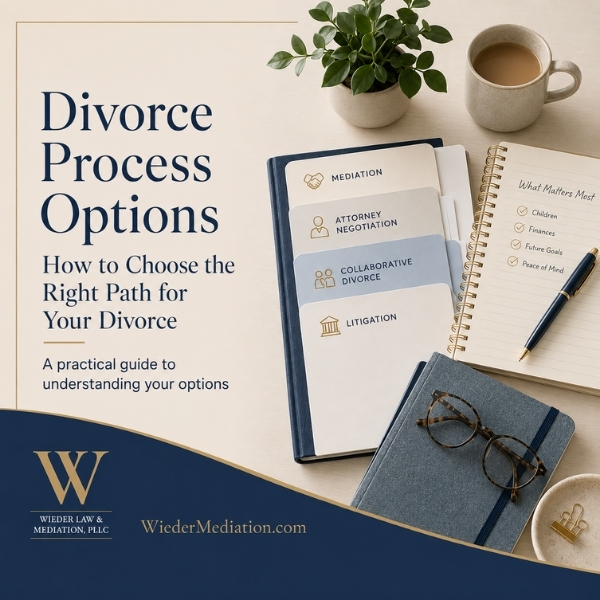
Divorce Process Options: How to Choose the Right Path for Your Divorce
Start with a Conversation
Every situation is different, and the best way to understand your options is to start with a conversation.
We’ll walk you through the process, answer your questions, and help you determine whether mediation is the right path for your situation.
Appointments are available in-person or via video conferencing.
Schedule a confidential consultation today and take the first step toward a more controlled, thoughtful resolution.