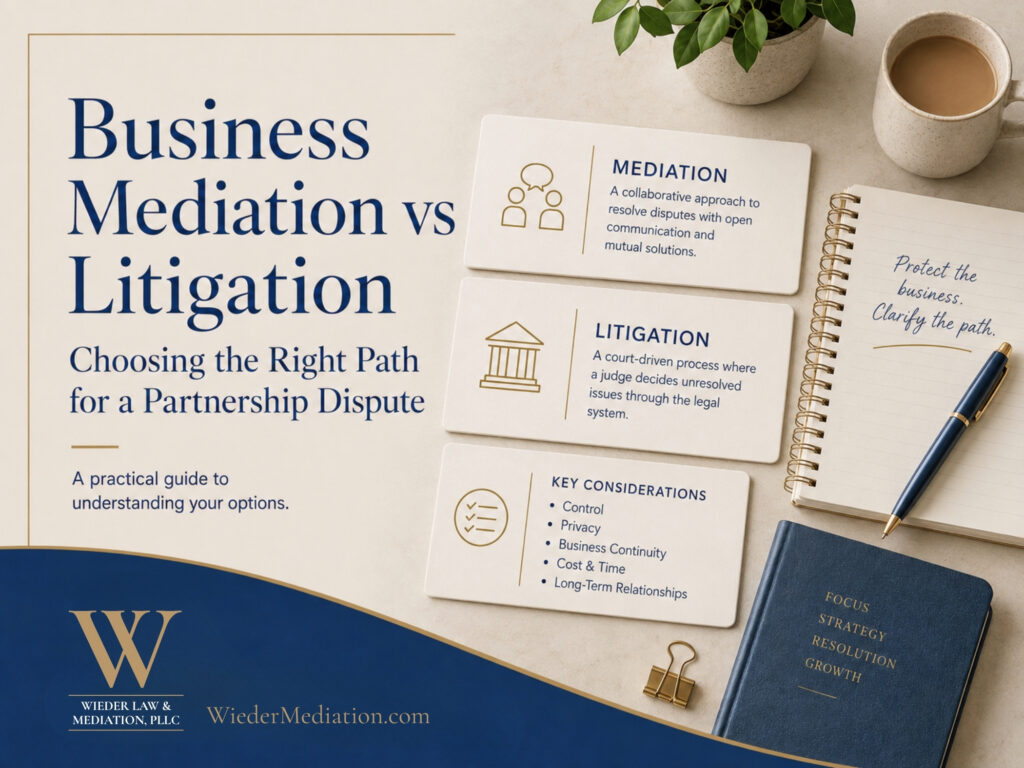
 Business Mediation vs Litigation: Choosing the Right Path for a Partnership Dispute
When business partners reach a serious disagreement, the conflict rarely exists in isolation. It can affect daily operations, employees, clients, finances, business relationships, and the future of the company itself.
The partners may disagree about money, management authority, ownership percentages, contracts, expansion plans, distributions, performance expectations, or whether one person should leave the business. Communication may have broken down, and informal attempts to resolve the problem may no longer be working.
At that point, the partners may begin comparing business mediation vs litigation.
Both are legitimate ways to address a business dispute, but they work very differently. Litigation asks a court to resolve legal claims through a formal judicial process. Mediation gives the people involved an opportunity to work toward a mutually acceptable resolution with the assistance of a neutral mediator.
Choosing the right path requires more than asking which process sounds easier. Business partners should consider the nature of the disagreement, the urgency of the situation, the legal and financial issues involved, the condition of the working relationship, and what each person ultimately needs from the resolution.
What Is Business Dispute Mediation?
Business dispute mediation is a structured negotiation process facilitated by a neutral third party.
The mediator doesn’t act as a judge and doesn’t decide who wins or loses. Instead, the mediator helps the participants identify the issues, exchange relevant information, communicate more productively, evaluate possible outcomes, and explore potential terms for an agreement.
Mediation is a process in which a neutral mediator helps the parties try to reach a mutually acceptable resolution. The mediator helps the parties communicate, but the parties retain responsibility for deciding whether to settle and what the settlement should include.
That distinction is important. In mediation, the business partners maintain a significant degree of control over the outcome. They aren’t required to accept an agreement simply because mediation has taken place.
Depending on the dispute, mediation may address issues such as:
- Ownership rights and responsibilities
- Management authority
- Financial contributions
- Compensation and distributions
- Contract interpretation
- Alleged breaches of fiduciary or contractual duties
- Access to company records
- Business valuation
- The departure or buyout of a partner
- Division of assets or client relationships
- Confidentiality and non-disparagement terms
- A plan for continuing, restructuring, or ending the business relationship
Mediation can be useful before a lawsuit is filed, while litigation is pending, or after the parties have already exchanged substantial legal and financial information.
For a broader overview of how mediation sessions are structured, see The Mediation Process.
What Is Business Litigation?
Business litigation is the formal process of resolving a dispute through the court system.
One party generally files a complaint setting out legal claims against another party. The opposing party may respond with defenses and counterclaims. The case can then proceed through document requests, depositions, motions, expert analysis, court conferences, settlement negotiations, and potentially a trial.
In litigation, the court applies legal rules to the claims and evidence presented. If the dispute proceeds to a decision, a judge or jury may determine liability, award damages, issue an injunction, interpret contractual rights, or grant another remedy permitted by law.
Litigation may be necessary when a party needs immediate court intervention, refuses to participate meaningfully in negotiations, withholds important information, violates ongoing legal obligations, or presents a serious risk to the company or its assets.
It can also be appropriate when the parties need a binding judicial ruling on a disputed legal question.
However, litigation usually gives the business partners less control over the final result. Each party can present arguments and evidence, but the ultimate decision may be made by someone outside the business who is limited to the remedies the law allows.
Business Mediation vs Litigation: The Most Important Differences
The right process depends on the facts of the dispute. Still, several fundamental differences can help business partners understand what each path involves.
Who controls the outcome?
In mediation, the parties decide whether an agreement will be reached and what its terms will be.
The mediator facilitates the discussion but doesn’t impose a resolution or decide the outcome. The parties work toward a mutually acceptable settlement with the mediator’s assistance.
In litigation, a judge or jury may determine the outcome if the case doesn’t settle first.
That can be necessary when the parties can’t agree or when one partner needs an enforceable court decision. However, it also creates uncertainty because neither side can fully control how the evidence, legal arguments, or requested remedies will ultimately be viewed.
How formal is the process?
Mediation is structured, but it’s generally more flexible than litigation.
The participants and mediator can focus on the specific financial, operational, legal, and relational issues driving the dispute. The process may include joint discussions, private conversations with the mediator, document review, and focused negotiation.
Litigation follows court rules, procedural deadlines, evidentiary standards, and formal filing requirements. These protections can be important, particularly when facts are contested or information must be compelled.
The formality of litigation may also increase the time, preparation, and professional resources required.
How private is the dispute?
Privacy is often a significant concern in a partnership dispute.
Business owners may not want allegations, internal financial information, customer issues, management disagreements, or proposed ownership changes discussed publicly.
Mediation is designed as a private and confidential dispute resolution process, although the specific scope of confidentiality should be addressed in the mediation agreement and considered under the applicable law.
Court proceedings and filings may be part of a public record unless they are sealed or otherwise protected. Certain confidential business information may receive legal protection, but parties shouldn’t assume that every allegation, filing, or development will remain private.
More general questions about mediation, confidentiality, and the mediator’s role are addressed in the firm’s Mediation FAQs.
What kinds of solutions are available?
Because mediation is a negotiated process, the participants can often consider practical business solutions that go beyond the narrower remedies typically available through litigation.
That flexibility can be especially useful when the dispute involves management, ownership, operations, compensation, client relationships, or the future structure of the business.
For example, an agreement might establish:
- A revised division of management responsibilities
- A staged partner buyout
- New approval procedures
- Independent financial oversight
- A plan for separating clients or territories
- Changes to compensation or distributions
- A transition period for a departing partner
- Confidentiality protections
- A process for resolving future disagreements
The ability to consider customized business solutions can be one of mediation’s most practical advantages.
What happens to the business relationship?
Not every partnership can or should continue.
However, even when the partners intend to separate, they may still need to communicate about employees, client files, debts, leases, taxes, intellectual property, pending work, or financial obligations.
Litigation can clarify rights and provide enforceable relief, but the adversarial structure may deepen an already damaged relationship.
Mediation doesn’t guarantee that the relationship will be repaired. It can, however, create a setting in which the participants address the practical decisions required to continue the business, restructure it, or separate more deliberately.
When Mediation May Be the Better Path
Mediation may be worth considering when both partners recognize that the dispute needs structured attention and are willing to participate meaningfully.
It may be particularly helpful when:
- The parties want to preserve some form of working relationship
- The business must continue operating while the dispute is addressed
- Privacy is a substantial concern
- The conflict includes business, financial, and personal dimensions
- The partners want more control over the resolution
- The dispute could benefit from a customized agreement
- Both parties have access to the information needed for productive negotiations
- The partners want to explore resolution before committing to prolonged litigation
Mediation may also help when the partners are capable of negotiating but can no longer communicate effectively without assistance.
A neutral mediator can help organize the conversation, separate central issues from longstanding frustrations, clarify what information is missing, and keep negotiations focused on decisions rather than accusations.
When Litigation May Be Necessary
Mediation isn’t appropriate for every business dispute.
Litigation may be necessary when:
- A partner needs emergency injunctive relief
- Business funds or assets may be transferred, hidden, or depleted
- A party refuses to provide essential information
- There are serious allegations of fraud or misconduct
- One party won’t participate honestly or meaningfully
- A legal deadline requires prompt action
- The parties need formal discovery to obtain evidence
- A controlling legal issue requires a judicial ruling
- A partner is violating an agreement and immediate enforcement is needed
- There is a significant imbalance in power, information, or control that can’t be addressed within mediation
Whether concerns about access to information, decision-making authority, or control can be managed within mediation depends on the circumstances, the structure of the process, and the availability of independent legal or financial guidance.
Speaking with an attorney about applicable claims, deadlines, risks, and possible remedies can be important before deciding how to proceed.
Does Choosing Mediation Mean Giving Up the Right to Litigate?
Participating in mediation doesn’t necessarily mean permanently giving up the option to pursue litigation.
If the partners don’t reach a complete agreement, they may still be able to pursue available legal remedies, subject to applicable agreements, laws, court orders, and filing deadlines.
Sometimes mediation resolves every issue. In other situations, it resolves only part of the dispute, narrows the issues, improves the exchange of information, or helps the parties better understand the risks of continuing.
Even partial progress can be valuable, but no one should assume that mediation pauses a statute of limitations or other legal deadline. Each party should seek legal guidance concerning deadlines and the preservation of legal rights.
Can Business Partners Mediate After a Lawsuit Has Started?
Yes. Mediation can take place before or after litigation begins.
Filing a lawsuit doesn’t necessarily mean the case will proceed all the way to trial. Alternative dispute resolution may still be used in business and civil matters while litigation is pending.
Once litigation has begun, the parties may have more information about the claims, defenses, documents, and financial risks involved. That information can sometimes make mediation more productive.
At the same time, the partners may already have incurred substantial legal expenses and become more firmly committed to their positions. Timing matters, and there isn’t one ideal mediation point for every dispute.
Early mediation may help prevent unnecessary escalation. Later mediation may benefit from information developed through discovery. The best timing depends on what the parties need to know before informed negotiations can occur.
Questions Business Partners Should Ask Before Choosing a Path
Before deciding between business mediation and litigation, each partner should consider several practical questions.
What result do we actually need?
A demand for money may be only one part of the dispute.
One partner may want access to records. Another may want to leave the business. Someone may be concerned about reputation, decision-making authority, clients, intellectual property, or future competition.
Identifying the real objectives can help determine whether the needed outcome is something the partners might negotiate or something that requires court intervention.
Is the business still operating?
An active business dispute may require immediate rules for payroll, client service, expenses, contracts, employee supervision, and financial access.
If the business must continue functioning, mediation may offer a setting for addressing temporary operating arrangements while the partners work toward a broader resolution.
However, urgent threats to the company may require immediate legal action.
Do both sides have enough information?
Meaningful negotiation depends on reliable information.
The partners may need financial statements, ownership documents, operating agreements, contracts, tax records, bank statements, valuations, or other business records.
When information is available voluntarily, mediation may move forward efficiently. When a party refuses to disclose material information, formal discovery through litigation may become necessary.
Can the disagreement be discussed safely and productively?
A difficult relationship doesn’t automatically prevent mediation.
Many participants enter mediation after trust and communication have deteriorated. However, each person must be able to participate, understand the issues, evaluate options, and make decisions without improper pressure.
The mediator and the parties may discuss whether separate sessions, attorneys, financial professionals, or other safeguards are appropriate.
What are the risks of delay?
Some disputes become more expensive or damaging when they remain unresolved.
Clients may leave, employees may become uncertain, accounts may go unpaid, opportunities may be missed, or the company’s value may decline.
The partners should consider both the risks of acting too quickly and the risks of allowing the dispute to continue without a structured process.
Preparing for Business Partnership Mediation
Preparation helps the mediation focus on informed decision-making rather than repeating the same arguments that have already failed.
Before mediation, partners may find it helpful to:
- Review the partnership, shareholder, or operating agreement.
- Identify the decisions that must be made.
- Gather relevant contracts and financial records.
- Separate confirmed facts from assumptions.
- Consider the needs of the business as well as individual positions.
- Identify acceptable, unacceptable, and negotiable outcomes.
- Speak with independent legal, tax, or financial professionals when appropriate.
- Think about what happens if no agreement is reached.
- Prepare to listen for practical concerns beneath the other partner’s stated demands.
- Consider both short-term arrangements and long-term solutions.
Good preparation doesn’t require deciding in advance that every issue must settle. It means arriving with enough information to evaluate options responsibly.
Choosing a Process That Fits the Dispute
The choice between business mediation vs litigation shouldn’t be based on the assumption that one process is always better.
Mediation can offer privacy, flexibility, direct participation, and the opportunity to develop practical terms tailored to the business. Litigation can provide formal discovery, legal enforcement, emergency relief, and a binding decision when the parties can’t resolve the matter themselves.
In some disputes, the right path may involve both. A party may need immediate legal protection while remaining open to mediation. A lawsuit may begin and later move into settlement discussions. Mediation may resolve part of a disagreement while leaving a narrow legal issue for the court.
A thoughtful decision starts with understanding the dispute, the business, the relationship between the partners, and the outcome each person needs.
Wieder Law & Mediation, PLLC provides business dispute mediation for partners and business owners in New York and New Jersey who want a structured, private setting in which to explore possible resolution.
The goal isn’t to pressure the participants into agreement. It’s to create a productive process where the issues can be understood, available options can be evaluated, and informed decisions can be made.
If you’d like to discuss whether mediation may be appropriate for your business dispute, you can schedule a complimentary consultation.
This article is for general informational purposes only and isn’t legal advice. Speaking with a qualified attorney or mediator can help you understand what may apply to your specific situation.
Frequently Asked Questions
Is mediation better than litigation for a business partnership dispute?
Neither process is automatically better. Mediation may be helpful when partners want privacy, flexibility, and greater control over the outcome. Litigation may be necessary when someone needs emergency relief, formal discovery, enforcement, or a binding court decision.
Can a mediator decide which business partner is right?
No. A mediator doesn’t act as a judge and doesn’t decide who wins. The mediator helps the partners identify issues, exchange information, communicate, and explore possible terms. The partners decide whether to enter into an agreement.
Is business dispute mediation confidential?
Business mediation is generally structured as a private and confidential process. The participants should review the mediation agreement and discuss the scope and limits of confidentiality before the process begins.
Can business partners mediate if they no longer trust each other?
Possibly. A lack of trust is common in business disputes and doesn’t automatically make mediation impossible. The process may need clear document exchange requirements, separate legal advice, private sessions, or other safeguards to support informed participation.
What happens if business mediation doesn’t resolve the dispute?
If no agreement is reached, the parties may still be able to pursue litigation or another dispute resolution process, depending on applicable contracts, court orders, laws, and deadlines. Mediation may also resolve some issues while leaving others open.
Should each business partner have an attorney during mediation?
The parties may choose to consult or attend with independent attorneys. Legal counsel can help a participant understand legal rights, evaluate proposals, prepare for mediation, and review a proposed agreement. The appropriate level of attorney involvement depends on the dispute.

Start with a Conversation
Every situation is different, and the best way to understand your options is to start with a conversation.
We’ll walk you through the process, answer your questions, and help you determine whether mediation is the right path for your situation.
Appointments are available in-person or via video conferencing.
Schedule a confidential consultation today and take the first step toward a more controlled, thoughtful resolution.