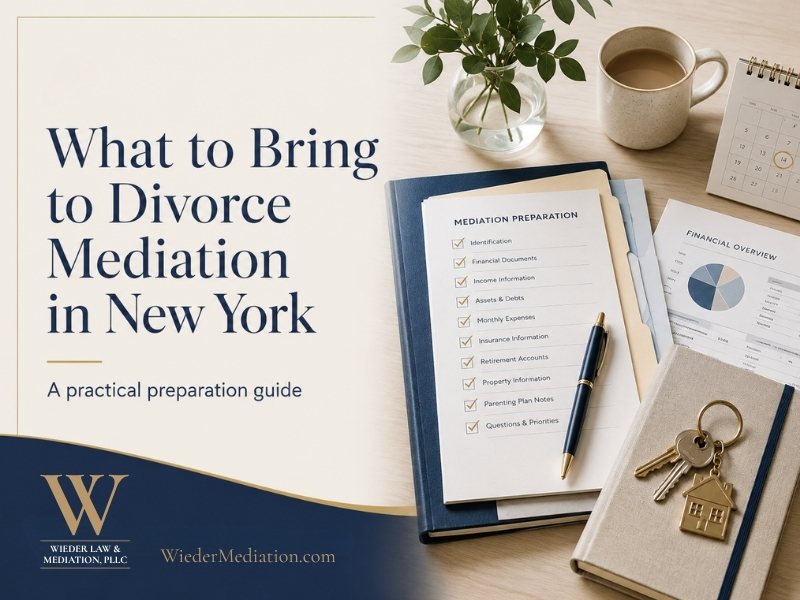
What to Bring to Divorce Mediation in New York
Preparing for divorce mediation in New York can feel overwhelming, especially when you’re not sure what information you’ll need or how much detail to gather before the first session.
The good news is that you don’t need to have everything figured out before mediation begins.
You do, however, want to come prepared with the right information so the conversation can stay focused, productive, and grounded in reality.
Divorce mediation is designed to help both spouses work through the issues that need to be resolved in a more private, structured, and practical way. Instead of beginning from a place of conflict, mediation creates a setting where both parties can identify what needs to be discussed and move toward workable agreements.
If you’re considering divorce mediation in New York, here’s what to bring, what to think through, and how to prepare before your first session.
Why Preparation Matters in Divorce Mediation in New York
Mediation works best when both parties have access to clear information.
That doesn’t mean every document must be perfect or every question must already have an answer. It simply means that the more organized you are, the easier it becomes to have meaningful discussions about property, finances, parenting, support, and future planning.
In many New York divorce matters, financial disclosure is an important part of the process. The New York Courts provide statewide divorce forms, including financial disclosure documents, and also recognize mediation as an alternative dispute resolution option for divorce and family-related matters.
The purpose of gathering information is not to overwhelm either spouse. It’s to create a more complete picture so decisions can be made carefully, fairly, and with fewer surprises.
1. Income and Employment Information
Start by gathering documents that show your current income and employment situation.
This may include:
- Recent pay stubs
- W-2 forms
- 1099 forms
- Recent tax returns
- Employment contracts
- Bonus or commission information
- Proof of self-employment income
- Business income records, if applicable
- Unemployment, disability, pension, or Social Security income information
Income information is often important when discussing support, household budgets, parenting arrangements, and future financial planning.
If either spouse owns a business, works on commission, receives bonuses, or has irregular income, it may be helpful to bring additional records that show a broader income history.
2. Tax Returns and Financial Records
Tax returns can provide a useful overview of income, deductions, business interests, investment activity, and other financial details.
Bring copies of your most recent tax returns, usually for the last two or three years if available.
You may also want to gather:
- Personal tax returns
- Business tax returns
- K-1 forms
- W-2s and 1099s
- Recent bank statements
- Investment account statements
- Retirement account statements
- Mortgage statements
- Credit card statements
- Loan documents
These records help create a clearer financial picture and reduce guesswork during mediation.
3. Bank Accounts, Retirement Accounts, and Investments
Divorce mediation often includes a discussion of marital assets and separate property. Having account information available can make those conversations more productive.
Bring information for:
- Checking accounts
- Savings accounts
- Money market accounts
- Brokerage accounts
- Stocks and bonds
- Retirement accounts
- IRAs
- 401(k) plans
- Pension information
- College savings accounts
- Cryptocurrency or digital assets, if applicable
You don’t necessarily need to bring every statement ever issued. A recent statement for each account is often a good place to begin.
If there are questions about when an account was opened, whether money was contributed before the marriage, or whether funds were inherited or gifted, those details may need to be reviewed more carefully.
4. Debts and Monthly Expenses
Assets are only one part of the financial picture. Debts and regular expenses are just as important.
Bring information about:
- Credit card balances
- Student loans
- Car loans
- Personal loans
- Medical debt
- Business debt
- Mortgage balances
- Home equity loans or lines of credit
- Tax debts
- Monthly household expenses
- Insurance costs
- Childcare expenses
- School or activity costs
- Health care expenses
This information helps both parties understand what obligations exist and what the financial reality may look like after divorce.
5. Real Estate and Property Information
If you own a home or other real estate, bring as much information as you reasonably can.
Helpful documents may include:
- Deeds
- Mortgage statements
- Property tax bills
- Homeowners insurance information
- Recent appraisals
- Home equity loan documents
- Lease agreements for rental properties
- Closing documents
- Records of major improvements or repairs
You may also want to think through practical questions before mediation, such as:
- Does either spouse want to remain in the home?
- Is selling the home being considered?
- Can one spouse afford the mortgage, taxes, and maintenance?
- Are there children whose school district or routine may be affected?
- Is there a realistic timeline for sale, refinance, or transfer?
These conversations can be emotional, especially when the family home is involved. Having accurate information can help keep the discussion focused on options instead of assumptions.
6. Parenting Information, If Children Are Involved
If you have children, mediation may include conversations about parenting time, decision-making, schedules, holidays, school matters, expenses, communication, and future routines.
Bring or think through:
- Current parenting schedule
- School schedules
- Work schedules
- Children’s medical needs
- Extracurricular activities
- Childcare arrangements
- Holiday traditions
- Transportation needs
- Special education or therapy information, if applicable
- Health insurance coverage
- Recurring child-related expenses
It can also help to think about what has been working well for your children and what may need to change.
Mediation is not just about dividing time. It is about creating a parenting structure that is realistic, stable, and focused on the needs of the children.
For more about the mediation process itself, visit The Mediation Process.
7. Insurance Information
Insurance is easy to overlook, but it can play an important role in divorce planning.
Gather information about:
- Health insurance
- Dental and vision insurance
- Life insurance
- Homeowners insurance
- Renters insurance
- Auto insurance
- Disability insurance
- Long-term care insurance, if applicable
Important questions may include:
- Who is currently covered under each policy?
- Will coverage change after divorce?
- Are children covered under one parent’s plan?
- Are there life insurance policies connected to support obligations?
- What are the current monthly premiums?
Understanding insurance early can help prevent problems later.
8. Important Legal or Financial Agreements
If you and your spouse have any agreements already in place, bring them to mediation.
This may include:
- Prenuptial agreements
- Postnuptial agreements
- Separation agreements
- Prior court orders
- Custody or support orders
- Business agreements
- Partnership agreements
- Trust documents
- Estate planning documents
These documents may affect what needs to be discussed and how certain issues are approached.
9. A List of Questions and Concerns
You don’t have to walk into mediation with every answer.
In fact, it’s often more helpful to come with clear questions.
Consider writing down:
- What are you most concerned about?
- What information do you still need?
- What issues feel urgent?
- What decisions need to be made first?
- What would make the process feel more organized?
- What outcomes are most important to you?
- Where might you be flexible?
- Where do you need more guidance before making decisions?
Divorce mediation is a process. The first session is often about identifying the issues, gathering information, and setting a path forward.
10. An Open Mind and a Practical Approach
Documents matter, but mindset matters too.
Mediation works best when both parties are willing to participate in good faith, listen carefully, and consider practical solutions. That doesn’t mean the process will always be easy. Divorce involves real concerns, real emotions, and real decisions.
But mediation gives both parties an opportunity to stay more involved in the outcome rather than turning every issue into a courtroom battle.
The goal is not to “win” against the other person.
The goal is to reach clear, workable agreements that allow both parties to move forward.
To better understand the difference between mediation and litigation, visit Mediation vs. Litigation.
Divorce Mediation in New York Preparation Checklist
Before your first mediation session, try to gather:
- Recent pay stubs
- Recent tax returns
- Bank account statements
- Retirement and investment account statements
- Mortgage and property records
- Credit card and loan balances
- Monthly household expense information
- Insurance policies
- Business records, if applicable
- Parenting schedules and child-related expense information
- Any prior agreements or court orders
- A list of questions and concerns
You don’t need to have everything perfect before you begin. The purpose of mediation is to create a structured process for working through the issues step by step.
When Should You Start Gathering Documents?
It’s helpful to begin gathering documents as soon as you start considering divorce mediation.
Even if you’re not ready to make decisions yet, getting organized can help you understand your financial picture and feel more prepared for the process.
If something is missing, that can usually be addressed during mediation. The key is to begin with what you have and identify what still needs to be collected.
How Wieder Law & Mediation Helps
At Wieder Law & Mediation, PLLC, the focus is on helping individuals, families, and professionals move through conflict with clarity, structure, and practical guidance.
Divorce mediation provides a private and more controlled way to address difficult issues without unnecessary escalation.
Howard Wieder serves as a neutral mediator, helping both parties stay focused on the issues that need to be resolved, including finances, parenting, property, support, and future planning.
Mediation sessions are available for clients in New York and New Jersey, with options for in-person or remote meetings.
To begin the process, schedule a complimentary consultation.
Frequently Asked Questions About Preparing for Divorce Mediation
Do I need every financial document before starting divorce mediation in New York?
No. It is helpful to gather as much information as you can, but you do not need every document before the first session. Mediation can help identify what information is missing and what needs to be collected.
Should I bring tax returns to divorce mediation?
Yes. Recent tax returns can provide important information about income, deductions, business interests, investments, and overall financial history.
What if my spouse has more access to the financial documents?
That is common. Mediation can help identify what documents are needed and create a process for exchanging information in a more organized way.
Do we need attorneys if we use divorce mediation?
A mediator does not represent either spouse or provide individual legal advice. Some people choose to consult with their own attorneys during or after mediation so they can better understand their individual rights before signing an agreement.
Is divorce mediation private?
Yes. Divorce mediation is a private and confidential process. Unlike litigation, which may involve court filings and public proceedings, mediation allows both parties to discuss sensitive financial, parenting, and personal matters in a confidential setting.
At Wieder Law & Mediation, all mediation discussions are handled with discretion and confidentiality so both parties can speak openly and work toward practical solutions in a private environment.
Can mediation help if we disagree about money or parenting?
Yes. You do not need to agree on everything before starting mediation. The purpose of mediation is to help both parties work through unresolved issues in a structured and productive way.
Ready to Prepare for Divorce Mediation?
If you’re considering divorce mediation in New York or New Jersey, preparation can help the process feel more manageable.
You don’t need to have every answer before you begin, you just need a clear starting point, the right information, and a process that helps move the conversation forward.
Schedule a Complimentary Consultation with Wieder Law & Mediation, PLLC to learn more about whether mediation may be the right path for your situation.
Recent Posts


Start with a Conversation
Every situation is different, and the best way to understand your options is to start with a conversation.
We’ll walk you through the process, answer your questions, and help you determine whether mediation is the right path for your situation.
Appointments are available in-person or via video conferencing.
Schedule a confidential consultation today and take the first step toward a more controlled, thoughtful resolution.