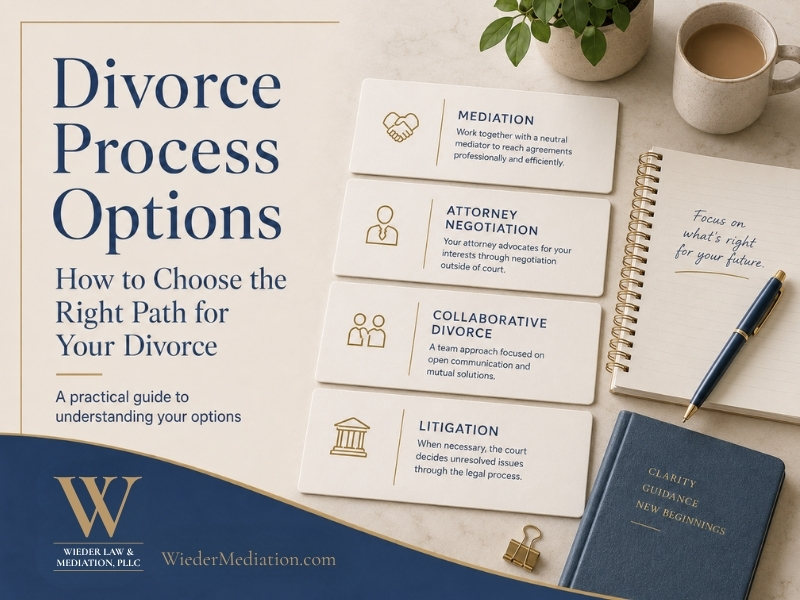
Divorce Process Options: How to Choose the Right Path for Your Divorce
Deciding to divorce is one decision. Deciding how to move through the divorce is another.
Many people begin the process believing there are only two choices: agree privately on everything or go to court. In reality, there are several divorce process options, and each offers a different level of structure, professional involvement, privacy, decision-making control, and court participation.
Spouses may negotiate directly, work with a divorce mediator, negotiate through separate attorneys, participate in a collaborative divorce process, or resolve contested issues through litigation. Some divorces use one approach from beginning to end, while others move between processes as circumstances change.
No single method is automatically right for every couple. Choosing a path requires an honest assessment of the issues, the communication between the spouses, the availability of financial information, the need for legal guidance, and each person’s ability to participate in informed decision-making.
Understanding the differences can help spouses choose a process that fits the realities of their situation rather than simply defaulting to the most familiar option.
What Are the Main Divorce Process Options?
The most common approaches include:
- Direct discussion between spouses
- Divorce mediation
- Negotiation through separate attorneys
- Collaborative divorce
- Divorce litigation
- Trial or judicial determination
These options exist along a spectrum.
At one end, the spouses make decisions through private, unassisted conversations. At the other, a judge determines unresolved issues after formal court proceedings. The approaches in between provide different combinations of professional assistance, negotiation, legal representation, and structure.
Although these paths can be described separately, they aren’t always completely distinct.
A litigated case may settle through attorney negotiation or mediation before trial. Spouses in mediation may consult independent attorneys. A couple may resolve some issues directly and seek professional help with others.
The important question isn’t simply, “Which process is best?”
A more useful question is, “Which process gives us the structure, information, support, and protection we need to make responsible decisions?”
Option 1: Direct Discussion Between Spouses
Some spouses begin by discussing the terms of their separation or divorce directly.
They may talk about finances, property, debts, living arrangements, support, insurance, taxes, or other practical matters without a mediator or attorneys participating in the conversations.
Potential benefits of direct discussion
Direct negotiation may offer several advantages:
- The spouses communicate with each other rather than through intermediaries.
- There may be little or no professional cost during the initial conversations.
- Discussions can occur on the spouses’ own schedule.
- The participants maintain control over the topics and possible solutions.
- It may help identify areas of agreement before professional services are needed.
For couples who communicate well, understand their finances, and have relatively straightforward issues, direct discussion may be a useful starting point.
Potential limitations of direct discussion
The absence of professional support can also create challenges.
There is no neutral person managing the discussion, identifying missing topics, or helping when communication becomes unproductive. Neither spouse may recognize important legal, financial, or practical issues that should be addressed.
One person may also have more financial knowledge, negotiating experience, or access to records than the other.
Even when spouses agree in principle, their understanding may not be detailed enough to create a complete and workable written agreement. They should consider obtaining legal advice before relying on informal arrangements or signing final documents.
Direct discussion may work best when both people can exchange information openly, communicate respectfully, and recognize when outside guidance is needed.
Option 2: Divorce Mediation
Divorce mediation is a structured negotiation process in which a neutral mediator helps spouses discuss and work through the decisions required for their divorce.
The mediator doesn’t act as a judge and doesn’t impose an outcome. The spouses remain responsible for deciding whether they will reach an agreement and what the terms will be.
New York Courts explains divorce mediation as an alternative process available to spouses who want assistance working through divorce-related issues. New Jersey Courts also uses economic mediation to help divorcing spouses seek common ground concerning property and financial support.
What happens during divorce mediation?
The specific process varies, but mediation commonly includes:
- Identifying the issues that must be resolved
- Gathering and exchanging relevant information
- Discussing each spouse’s concerns and priorities
- Reviewing financial circumstances
- Considering possible settlement options
- Testing whether proposed terms are realistic
- Identifying areas of agreement and disagreement
- Developing a written understanding of the proposed resolution
A fuller overview is available on our Mediation Process page.
The mediator helps organize the process and maintain a productive conversation. However, the mediator doesn’t represent either spouse individually.
Each person may choose to consult an independent attorney for legal advice, document review, or assistance understanding the consequences of a proposed agreement.
Potential benefits of divorce mediation
Mediation may offer:
- Direct but professionally guided communication
- Greater privacy than public court proceedings
- More control over the final terms
- Flexibility in scheduling and problem-solving
- The ability to address practical concerns alongside legal issues
- A process designed around informed negotiation
- The opportunity to create terms tailored to the spouses’ circumstances
Because the spouses participate directly, they can explain what matters to them rather than relying entirely on professionals to communicate on their behalf.
Potential limitations of divorce mediation
Mediation depends on meaningful participation.
The mediator generally can’t compel a spouse to produce information in the same way a court can through formal discovery. The mediator also can’t force someone to answer a question, accept a proposal, or sign an agreement.
Mediation may be difficult when:
- One spouse refuses to disclose important information
- A participant can’t advocate for their own concerns
- There is significant intimidation or coercion
- One person is trying to delay the process
- Immediate court protection is needed
- A spouse is unwilling to negotiate in good faith
- There is an extreme imbalance in knowledge or control that can’t be addressed
These concerns don’t automatically rule out mediation in every situation. The process may sometimes be structured with separate sessions, independent attorneys, financial professionals, or other safeguards.
However, mediation shouldn’t be treated as a one-size-fits-all solution. Its suitability should be considered carefully.
Option 3: Negotiation Through Separate Attorneys
In attorney negotiation, each spouse retains an attorney who provides independent legal advice and communicates proposals with the other spouse’s attorney.
The spouses may exchange information voluntarily, discuss potential terms with their attorneys, and authorize their attorneys to negotiate on their behalf.
This approach can occur before a court case is filed or while litigation is pending.
Potential benefits of attorney negotiation
Attorney negotiation provides each spouse with an advocate focused on that person’s legal interests.
It may be appropriate when:
- Each spouse wants ongoing legal advice
- Direct communication is difficult
- The legal or financial issues are complex
- The spouses need help evaluating settlement proposals
- One or both parties aren’t comfortable negotiating directly
- A formal but non-trial resolution remains possible
Attorneys can identify legal issues, explain possible outcomes, prepare proposals, review financial information, and draft settlement documents.
Potential limitations of attorney negotiation
The process may become indirect because many substantive conversations occur between the attorneys rather than between the spouses.
That can be helpful when communication is highly strained, but it can also make the spouses feel removed from decisions that will affect their lives.
The pace, tone, and cost of the process may be influenced by the professionals involved, the number of communications required, the complexity of the issues, and the willingness of everyone to exchange information efficiently.
Attorney negotiation also doesn’t guarantee that the case will settle. If the spouses remain unable to agree, they may proceed to mediation, litigation, or trial.
Option 4: Collaborative Divorce
Collaborative divorce is an out-of-court process in which each spouse retains a collaboratively trained attorney and everyone commits to working toward a negotiated resolution.
The process typically involves a written participation agreement. The spouses and their attorneys agree to exchange relevant information and resolve the issues without asking a court to decide the contested matters.
If the collaborative process ends without an agreement and the spouses move into contested litigation, the collaborative attorneys generally withdraw, and the spouses retain new litigation counsel.
The American Bar Association’s dispute-resolution overview describes collaborative practice as an out-of-court settlement process in which the parties and their lawyers work toward an agreement. If the process ends and contested litigation follows, the collaborative lawyers generally can’t continue as litigation counsel.
How is collaborative divorce different from mediation?
In mediation, one neutral mediator facilitates discussions between the spouses. The mediator doesn’t represent either person.
In collaborative divorce, each spouse has an attorney providing individual legal representation throughout the negotiations.
Collaborative cases may also involve neutral or jointly retained professionals, such as:
- Financial specialists
- Business valuation professionals
- Divorce coaches
- Tax professionals
- Other subject-matter specialists
The professional team depends on the needs of the case. Not every collaborative divorce requires every type of professional.
Potential benefits of collaborative divorce
Collaborative divorce may offer:
- Independent legal representation for each spouse
- Direct participation in settlement discussions
- A structured commitment to resolving matters outside court
- Coordinated assistance from financial or other professionals
- Private negotiation
- A team-based approach to complex decisions
- Greater opportunity for creative and customized agreements
This approach may be helpful when both spouses want legal representation but also want to avoid preparing the case as an adversarial court contest.
Potential limitations of collaborative divorce
Collaborative divorce requires a significant commitment from both spouses.
If the process doesn’t result in a settlement, the collaborative attorneys usually can’t represent the spouses in the contested litigation that follows. The spouses must retain new counsel, which can add expense, time, and duplication of effort.
Costs may also increase when several professionals participate. Those professionals can provide valuable expertise, but their involvement should be purposeful and proportional to the needs of the case.
Collaborative divorce generally works best when both spouses are willing to disclose information, negotiate transparently, and remain committed to reaching an out-of-court resolution.
Option 5: Divorce Litigation
Divorce litigation uses the formal court process to resolve disputed issues.
One spouse files the required legal documents, and the other spouse responds. The case may involve financial disclosures, document requests, depositions, court appearances, expert evaluations, motion practice, settlement conferences, and negotiations.
Litigation doesn’t necessarily mean the spouses will go to trial. Many litigated cases settle before a judge issues a final decision.
The distinction is that the court process is available to manage the case, enforce deadlines, compel disclosure, issue temporary orders, and decide unresolved issues when necessary.
Potential benefits of litigation
Litigation may be needed when:
- A spouse refuses to provide necessary financial information
- Facts must be established through formal discovery
- There are serious disagreements about the law
- One party needs temporary or emergency court orders
- Assets may be hidden, transferred, or depleted
- A spouse refuses to participate in another process
- Negotiation repeatedly fails
- A binding judicial ruling is required
- There are substantial concerns about intimidation, coercion, or safety
Court procedures provide mechanisms that private negotiation and mediation don’t have. A court can require disclosure, enforce its orders, address violations, and issue a decision even when the spouses can’t agree.
Potential limitations of litigation
Litigation may involve significant time, financial expense, preparation, and emotional energy.
The spouses generally have less control over the schedule and, if the matter proceeds to a decision, less control over the outcome. Court procedures focus on legal claims, evidence, and available remedies rather than every personal or practical concern the spouses may have.
Formal conflict may also become more difficult to contain once the case is structured around competing legal positions.
However, litigation shouldn’t be portrayed as a failure. In some circumstances, judicial involvement is necessary to protect rights, obtain information, enforce obligations, or bring an unresolved matter to a conclusion.
Option 6: Trial and Judicial Determination
Trial is the stage at which a judge hears evidence and arguments and makes decisions on unresolved issues.
The spouses and their attorneys present testimony, documents, expert opinions, and legal arguments. The judge applies the relevant law and issues a binding determination, subject to any available post-trial motions or appeals.
Potential benefits of trial
Trial provides a path to resolution when the spouses can’t agree.
It may establish disputed facts, interpret legal rights, determine financial obligations, and create enforceable orders.
For someone dealing with persistent noncooperation, concealed information, or fundamentally incompatible positions, a judicial determination may provide necessary closure.
Potential limitations of trial
The spouses surrender substantial control over the final result.
Each person may believe strongly in their interpretation of the facts and law, but neither can guarantee how a judge will evaluate the testimony, credibility, evidence, or legal arguments.
Trial preparation can also require extensive attorney time, expert involvement, document organization, and repeated court appearances.
For these reasons, many cases continue exploring settlement even after litigation begins.
Divorce Mediation vs Collaborative Divorce
Mediation and collaborative divorce are both designed to help spouses resolve matters outside a contested trial, but they aren’t the same.
| Divorce mediation | Collaborative divorce |
|---|---|
| One neutral mediator facilitates the process | Each spouse has a collaboratively trained attorney |
| The mediator doesn’t represent either spouse | Each attorney represents one spouse |
| Independent attorneys may consult outside sessions | Attorneys participate directly in the process |
| Additional professionals may be used when helpful | A coordinated professional team may be part of the model |
| Spouses may still litigate with their chosen consulting attorneys if mediation ends | Collaborative attorneys generally withdraw if contested litigation begins |
| Often has a simpler professional structure | May involve a more extensive professional structure |
Neither option is universally better.
Mediation may appeal to spouses who are comfortable participating directly and want a neutral professional to guide the conversation.
Collaborative divorce may appeal to spouses who want each person represented throughout the negotiations while maintaining a formal commitment to resolving the divorce outside contested litigation.
Divorce Mediation vs Attorney Negotiation
The primary difference is who participates in the substantive discussions.
In mediation, the spouses generally communicate directly with the assistance of the mediator. In attorney negotiation, the attorneys may conduct much of the communication.
Mediation can provide greater visibility into the conversation and give each spouse an opportunity to explain concerns firsthand.
Attorney negotiation can provide distance when direct communication is too difficult or when each person wants an advocate handling the exchange of proposals.
These approaches can also overlap. Spouses may attend mediation while consulting separate attorneys before, during, or after the process.
Can You Change Divorce Processes After You Begin?
Choosing one process doesn’t always mean remaining in it until the divorce is complete.
Spouses who begin with direct discussions may later retain a mediator. Mediation participants may consult attorneys or transition to litigation if the process isn’t productive. A litigated case may move into mediation or settlement negotiations.
New York Courts recognizes both divorce mediation and collaborative law as alternatives that may help spouses work toward resolution without a trial. The New York Courts divorce FAQ also suggests considering mediation or collaborative law when spouses need help reaching an agreement.
Changing processes can create additional expense or require some work to be repeated, particularly if the original professionals can’t continue in the new process.
Still, discovering that a chosen process no longer fits doesn’t mean the spouses must remain in an unproductive approach.
How Much Does Each Divorce Process Cost?
There isn’t a reliable universal price for mediation, collaborative divorce, attorney negotiation, or litigation.
The cost of any divorce process can depend on:
- The number and complexity of the issues
- The amount of financial information involved
- Whether records are organized and readily available
- The level of disagreement
- Each spouse’s willingness to exchange information
- The number of meetings or court appearances required
- Attorney and professional hourly rates
- Whether valuations or expert opinions are needed
- Whether temporary disputes arise
- Whether the case settles or proceeds to trial
A process that is typically less formal isn’t necessarily inexpensive if negotiations continue for a long time or information is difficult to obtain.
Similarly, litigation doesn’t always lead to trial. A litigated case may settle relatively early, while another may require extensive discovery and hearings.
Rather than relying on broad cost estimates, spouses should ask prospective mediators and attorneys about billing practices, anticipated professional involvement, deposits or retainers, and the factors most likely to affect the total cost.
How Long Does Each Divorce Process Take?
Timing also varies considerably.
A relatively straightforward mediation may proceed more quickly than a case involving extensive financial analysis, but the number of sessions alone doesn’t determine when a divorce will be completed.
Timing may be affected by:
- How quickly documents are gathered
- The availability of the spouses and professionals
- The complexity of the financial issues
- Whether outside appraisals or valuations are required
- The pace of negotiations
- Court filing requirements
- Local court schedules
- Whether the spouses reach a complete agreement
- Whether a judge must decide contested issues
New York and New Jersey court procedures also differ, and timing may vary by county.
Anyone promising an exact completion date before understanding the case should be viewed cautiously.
Questions to Ask When Choosing a Divorce Process
Can we communicate directly?
The spouses don’t need to agree or communicate perfectly for mediation to work.
However, each person must generally be able to express concerns, review information, consider proposals, and make voluntary decisions.
When direct discussion isn’t productive, attorney negotiation or litigation may offer a more appropriate structure.
Will both spouses disclose financial information?
Every divorce process depends on accurate information.
Mediation and collaborative divorce rely heavily on voluntary and transparent disclosure. If a spouse refuses to provide records or there is reason to believe information is being concealed, formal discovery may be necessary.
Does either person need immediate protection or a court order?
Urgent financial, legal, or personal concerns may require court involvement.
A consultation with independent counsel can help determine whether immediate action is necessary before private negotiation begins or continues.
How much professional guidance does each spouse need?
Some people are comfortable gathering documents, discussing options, and consulting an attorney only at key points.
Others want legal advice and representation throughout every stage.
The right amount of professional involvement depends on the complexity of the case and each person’s ability to understand and evaluate the decisions.
Are there complicated financial issues?
Businesses, trusts, real estate, deferred compensation, investments, retirement assets, or substantial debt may require additional professional analysis.
Complexity doesn’t automatically rule out mediation, but the process should provide access to the information and expertise needed for informed decisions.
Does either spouse have difficulty advocating for themselves?
A significant imbalance in confidence, knowledge, financial control, or negotiating ability deserves careful attention.
A mediator may be able to structure the process to improve participation, but some imbalances require independent attorneys or court oversight.
What happens if we don’t reach an agreement?
Each spouse should understand the alternative to settlement.
That may mean attorney negotiation, court proceedings, additional financial disclosure, motion practice, or trial.
Understanding the next available step can make it easier to evaluate proposals realistically without creating pressure to accept an unsuitable agreement.
Preparing for Divorce Mediation
Spouses considering mediation can begin by gathering the information that will be needed for an informed discussion.
The existing Wieder Law & Mediation resource, What to Bring to Divorce Mediation in New York, provides a practical overview of financial records and other materials that may help spouses prepare.
Preparation doesn’t mean deciding every outcome before the first session. It means having enough reliable information to understand the issues and evaluate possible terms.
Choosing a Process Based on the Situation, Not the Label
People sometimes choose a divorce process based on how they hope the divorce will feel.
They may believe mediation will guarantee cooperation, collaborative divorce will eliminate disagreement, or litigation will automatically produce fairness.
No process can guarantee those results.
The effectiveness of a process depends on the people involved, the information available, the professionals assisting them, the complexity of the decisions, and the willingness of each person to participate responsibly.
A thoughtful process choice considers both opportunity and risk.
Mediation may provide direct communication, privacy, and control, but it requires meaningful participation and adequate disclosure.
Collaborative divorce provides individual legal representation within a settlement-focused structure, but it may require new attorneys if the process ends.
Attorney negotiation offers advocacy and professional distance, but the spouses may feel removed from the conversations.
Litigation provides enforcement, discovery, and judicial decision-making, but it can require the spouses to surrender control over important outcomes.
The goal isn’t to select the process that sounds most peaceful or most forceful. It’s to choose the structure most likely to support informed, workable decisions under the actual circumstances.
Exploring Divorce Mediation in New York or New Jersey
For spouses who can exchange information and participate in guided discussions, divorce mediation may offer a structured path toward resolving the terms of their divorce.
The mediator helps organize the conversation, clarify the decisions that must be made, and support productive negotiations. The spouses remain responsible for the outcome and may consult independent attorneys or financial professionals as needed.
Wieder Law & Mediation, PLLC provides divorce mediation for spouses in New York and New Jersey who want to explore a private, thoughtful, and practical resolution process.
Answers to common questions are available in the firm’s Mediation FAQs. Spouses who are ready to discuss whether mediation may fit their situation can also schedule a complimentary consultation.
This article is for general informational purposes only and isn’t legal advice. Speaking with a qualified attorney or mediator can help you understand what may apply to your specific situation.
Frequently Asked Questions
What are the main divorce process options?
The main divorce process options include direct discussion, divorce mediation, negotiation through separate attorneys, collaborative divorce, litigation, and trial. Some spouses use more than one approach before reaching a final resolution.
How is divorce mediation different from litigation?
In mediation, a neutral mediator helps the spouses negotiate, but the spouses decide whether to agree and what the terms will be. In litigation, the court manages the formal process and a judge may decide any issues the spouses can’t resolve.
What is the difference between divorce mediation and collaborative divorce?
Mediation uses one neutral mediator who doesn’t represent either spouse. In collaborative divorce, each spouse has an attorney who participates in the negotiations. Collaborative attorneys generally can’t represent the spouses in contested litigation if the collaborative process ends without an agreement.
Is mediation always the least expensive divorce option?
Not necessarily. Mediation often involves fewer professionals and less formal procedure, but the total cost depends on the complexity of the issues, the number of sessions, the availability of information, and whether outside legal or financial assistance is needed.
Can we try mediation after a divorce case has been filed?
Yes. Mediation may take place before or after a divorce action begins. Some litigated cases use mediation to resolve all or part of the dispute before trial.
How do we know whether divorce mediation is appropriate?
Mediation may be appropriate when both spouses can participate voluntarily, exchange necessary information, consider proposals, and make informed decisions. It may not be suitable when immediate court protection is needed, important information is being withheld, or an imbalance can’t be managed appropriately within the process.



Start with a Conversation
Every situation is different, and the best way to understand your options is to start with a conversation.
We’ll walk you through the process, answer your questions, and help you determine whether mediation is the right path for your situation.
Appointments are available in-person or via video conferencing.
Schedule a confidential consultation today and take the first step toward a more controlled, thoughtful resolution.